
What's Happening Now?
ATA provides a snapshot of the current news, events, articles, podcasts, and more. ATA members receive a monthly e-newsletter that highlights this vital information.
ATA actively works with government agencies and organizations on the issues that affect you. Through ATA's advocacy efforts, you will benefit from the success we achieve together. Being an ATA member supports these efforts.

As a courtroom interpreter for the Texas immigration system, it was Meenu Batra’s job to ensure migrants understood the proceedings of immigration court—the good and the bad.
In March, Batra was exposed to the other side of the immigration system when she was detained and then arrested by the Department of Homeland Security (DHS) after decades spent living and working in the U.S. DHS called Batra an “illegal alien” and said she was arrested during a “targeted enforcement operation.”
Batra, a mother of four U.S. citizens who transitioned to interpreting in other courtrooms after years spent in immigration court, was held for more than six weeks—a harrowing experience from which she’s still recovering.
When Batra was arrested at Valley International Airport in Harlingen, Texas, she said she felt like she was falling “into a black hole.” “Fear” and “numbness” poured through her body as an officer asked her to step outside of the Transportation Security Administration (TSA) line and later handcuffed her outside the airport.
Batra’s attorney, Deepak Ahluwalia, said he believed she was targeted at the airport based on the flight’s manifesto. He cited a Reuters review of internal Immigration and Customs Enforcement data that found TSA shared over 31,000 traveler records with U.S. Immigration and Customs Enforcement, leading to over 800 arrests.
The process of being arrested, processed, and detained was “humiliating,” Batra said. “You just become smaller and smaller with each moment. Even way before I was in a cell, you start feeling imprisoned already.”
Batra said her experience in detention has given her even more insight into the experience migrants face in the American court system. As a fluent English speaker who understood immigration laws from years spent working as a courtroom interpreter, Batra said she saw herself as a person of “privilege” in the detention center, with a responsibility to help other detainees understand their rights and advocate for themselves. Some detainees had been behind bars for years, she said.
Now she hopes her experience will help highlight the ordinary people detained by DHS—and “how we are denying the basic human rights to people who have been and who are part of this society and this country. I’m just hoping that this brings some attention to those who don’t have a voice,” she said.
In the days after she was detained, Batra called her adult daughter—a challenging reversal of her usual role as a single mom who prided herself on providing support and stability for her children—who quickly hired an immigration lawyer to fight for her mother’s release. The legal team filed a petition on March 26 for habeas corpus, a form of relief whose use has skyrocketed in immigration cases since Trump took office again.
Federal Judge Rolando Olvera granted Batra’s request for a temporary restraining order on April 30, ordering DHS to release her and not detain her again “until they have provided her with notice of the reasons for re-detention and an opportunity to respond.” The judge wrote that Batra “was arrested and detained for no discernible reason, with no identified change in circumstance bearing on the likelihood of removal.”
The temporary restraining order preventing Batra from being detained is set to expire on May 27. Ahluwalia, her attorney, said he expects the habeas petition will be ruled in their favor, keeping Batra out of detention.
But the ramifications of her detention are long-lasting. Batra said her daughter has struggled to sleep through the night in the days since her mother returned home. She jumps when a car passes on the street out of fear that “somebody is coming to get mom,” Batra said.
“It’s a new reality we’re living in,” Batra said. Living close to the border, DHS vehicles and officers are a frequent sight, and a potent reminder of Batra’s ordeal and her still uncertain future.
Despite this, Batra said she has kept her faith in America’s ideals. The country “is based on people who want to work hard, and that is a fundamental human right—that we can dream and make attempts to live a better life for ourselves,” she said. “I believe we must stand up for those ideals, to protect those and to make sure that they are there for other generations that are coming.”
CNN (5/26/26) By Zoe Sottile
The U.S. Department of Education closed the Office of English Language Acquisition (OELA) on May 14, over a year after gutting its staff to just one. The office reportedly had around 15 employees.
The office was the only arm of the federal agency dedicated to ensuring that English learners and immigrant students gained English proficiency and academic success, that schools preserved students’ heritage languages and cultures, and that all students had the chance to develop biliteracy or multiliteracy skills.
Advocates and lawmakers have warned that the move could compromise English language support for students nationwide and will lead to reduced accountability and expertise for districts.
“Congress created OELA to ensure that English learners and immigrant students develop English proficiency,” wrote House Education and Workforce Committee Ranking Member Bobby Scott.
“English learners should never be treated as a siloed program, set aside as an afterthought,” said Kirsten Baesler, assistant secretary in the Office of Elementary and Secondary Education. “When English language acquisition is embedded across core priorities like literacy, academic content, educator preparation, and accountability, it receives the seriousness and sustained focus it deserves.”
K-12 Drive (5/14/26) By Naaz Modan
Throughout 2025 and early 2026, a flurry of language access legislation has been proposed in the U.S. after President Trump enacted Executive Order (EO) 14224, declaring English the official language of the United States, and revoking EO 13166, which had previously required federal agencies to provide language access for members of the public with limited English proficiency (LEP).
Most of the proposed bills aim to codify mandates for language access into law or unify and standardize guidelines for language services that are already provided under existing mandates.
On April 30, 2026, Representative Judy Chu introduced a somewhat different language access bill before the House of Representatives aimed at creating a new body within the federal government. The bill is entitled “to establish the Language Access Board, and for other purposes,” and is also known as the “Language Access Board Act of 2026” (H.R. 8604).
As the name suggests, the bill would create an independent “Language Access Board” within the federal government. The bill would also mandate all federal agencies to “ensure” that LEP communities have access to all public-facing resources and materials related to their programs or initiatives. Specifically, they would have to ensure that LEP access is “comparable” to the level of access given to fluent English speakers.
If the bill passes, it would be the Language Access Board’s responsibility to verify that this language access is being offered and to create standards for exactly how it should be provided.
The proposed Board would achieve this in several ways. First, they would have two years from the date the bill is enacted to develop specific language access standards for federal agencies. These standards would be developed after consultation with relevant heads of federal agencies and non-government organizations.
The published standards would then be reviewed and amended on a five-year cycle to address new technological advances, changes to federal programs or initiatives, and changes in the demographics of LEP communities or in the “language access needs of such individuals and communities.”
Federal agencies would have six months from the time the standards are published to incorporate them into their internal language access policies. The same timeframe would be given when new amendments are added to the standards.
However, the bill would also create a framework for federal agencies to apply for a waiver if particular language access requirements cause an “undue burden.” Such waivers would only stay in place for two years once approved.
At the same time, the board would have the power to hold public hearings and issue orders of compliance requiring federal agencies to adhere to their language access standards. This would include the executive director of the Board having the power to bring a “civil action” against noncompliant agencies in U.S. district courts.
At the time of writing, the bill has been referred to the House Committee on Oversight and Government Reform.
Slator (5/21/26) By Brandon Loch
A bill intended to connect Missourians in need with community resources has passed the Missouri House of Representatives, setting up a final vote in the state Senate that would send it to Governor Mike Kehoe.
Senate Bill 1062, sponsored by Senator Jill Carter, would direct the Missouri Department of Social Services to create a program aimed at strengthening communication access services for Missourians who are Deaf, Deaf-Blind, or hard of hearing.
A provision added to Carter’s bill by Senator Patty Lewis would create a program within the Missouri Commission for the Deaf and Hard of Hearing to improve access to interpreters, translation services, and open or closed captioning in businesses and state agencies. It would include a registry of communication access providers in the state and provide consultation and training to organizations working to improve their accessibility.
The federal Americans with Disabilities Act requires businesses and public entities to provide free, timely communication services.
But Deaf and hard-of-hearing witnesses who testified during a House committee meeting in April said communication services are also absent. They said businesses often told them they couldn’t afford to hire interpreters.
Speaking through an interpreter, Crystal Rush, an executive assistant at the Missouri Commission for the Deaf and Hard of Hearing, told lawmakers that when her father’s hospice care provider learned her family would need an interpreter, they were told they’d have to wait a month for service. During that time, Rush said, her father’s health rapidly declined.
“We didn’t have any idea if he was suffering,” Rush said. “We were left alone, and it wasn’t because there wasn’t help that existed. It was simply because there was no communication access available.”
Rush’s father, the only member of her family who was hearing, died from dementia days before hospice providers were scheduled to arrive. When Rush and her family called 911, they struggled to communicate with emergency personnel. With an interpreter, Rush said, her family would’ve been supported through their shock and grief.
“Communication,” Rush said, “is a human right.”
Missouri Independent (5/8/26) By Nu Steph Quinn

This space is dedicated to celebrating the accomplishments of our members!
Kate Deimling’s debut poetry collection, Time Traveling, was published by Cornerstone Press.
Submit Your Member News!
Do you have news to share with us? If so, you might be featured on our social media channels.
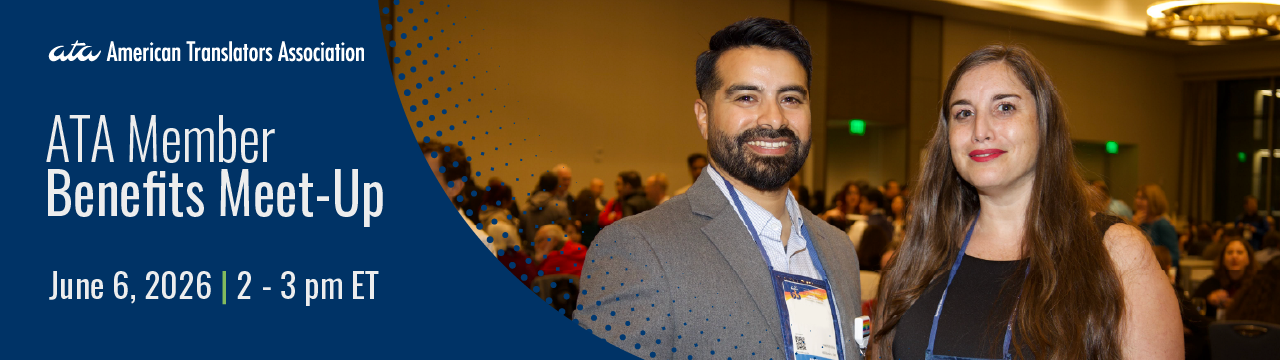
Don’t miss this opportunity to explore ATA membership and all the benefits that come with it!
Join us for a FREE meet-up on Saturday, June 6 at 2:00 p.m. EDT to learn how ATA supports our members by providing education, events, community, and more.
For members and non-members alike, this is a great opportunity to:
- Learn more about ATA member benefits, services, and discounts.
- Discover upcoming events, including ATA’s Annual Conference.
- Get answers to your questions from ATA’s Membership Committee.
We hope you’ll consider joining the session, and we look forward to seeing you there!
Can’t make this session?
This live session is an interactive, real-time experience and will not be recorded. Register for one of our additional sessions this year:

Join us as we tackle common challenges that legal translators face when working across different legal systems. How do you translate an LLC when there is no exact equivalent in…
Go beyond entity names and corporate documents to tackle some of the most challenging concepts in corporate law translation, including shareholder rights, stock options, RSUs, phantom shares, and other equity-based…

The Membership Development Committee develops and supports initiatives aimed at membership growth and retention. Learn more about the Membership Development Committee. This is a closed meeting for committee members only.…

Struggling to find a niche that offers steady, long-term income amidst the AI chaos? Learn how to thrive in the official document niche. This webinar shows how translators at any…

Artificial intelligence is playing an ever-increasing role in the language services industry. Everyone—from individual translators and interpreters to the CEOs of the largest language services companies—is struggling to adapt to…
This space is dedicated to celebrating the accomplishments of our members!
Kate Deimling’s debut poetry collection, Time Traveling, was published by Cornerstone Press.
Submit Your Member News!
Do you have news to share with us? If so, you might be featured on our social media channels.

Announcing The ATA Savvy Linguist
We have published the ATA Savvy Newcomer since 2013 and ATA Next Level since 2021. Each blog has made unique and helpful contributions to our members. Savvy Newcomer was founded…


Professional Medical Interpreters: Four Signs of a True Pro
If you work in healthcare, chances are you’ve encountered limited English proficiency (LEP) patients who aren’t fully comfortable communicating in English. When no professional interpreter is available, it’s tempting to…

E117: What is the International Federation of Translators (FIT)?
From education to celebration, FIT supports the professions by hosting events, providing online education, and promoting International Translation Day.


The ATA Chronicle
ATA’s flagship publication since 1972 The ATA Chronicle is the official publication of the American Translators Association. Published six times per year, each issue offers resources and practical solutions to…
Free Monthly Webinar
ATA offers members a free webinar each month, available on-demand for 30 days. Don't miss this month's freebie!

From Securitization to Tokenization: What FinTech Translators Need to Know
Gain the knowledge you need to confidently translate and interpret the language of tokenization, a fast-growing area reshaping financial markets and redefining key concepts in structured finance. As financial systems…



Issues of Newsbriefs
Get the Member Advantage
ATA members are ready for any challenge with the support of a collaborative community, effective education, and 24/7 promotion in ATA’s Language Services Directory.
Get Noticed!
Advertise in Newsbriefs to reach ATA members each month. Consistently high open rates guarantee your advertising will be seen by thousands of professionals!